Garden offices – living, breathing, eco-friendly buildings


British grown wood, eco-sensitive materials and time-tested construction methods are combined to make a super-insulated, eco-friendly garden office you will love spending time in. We are “breathing” construction enthusiasts. This proven timber frame system is respected by professionals who design environmentally considerate buildings. Breathing construction keeps your office or garden room warm, dry and great to be inside.


Working on eco-friendly garden officeDouble insulation = minimal heating and no air conditioning

Each garden room, studio and garden office has a balanced, airy environment. Double layers of insulation are used so that condensation won’t form inside.


Natural materials = low maintenance and low running costs

No chemicals are needed to preserve these eco-friendly garden offices, now or in the future. We choose sustainable materials that:

  • Need minimal maintenence.
  • Are grown or made in the UK.
  • Use less energy and fewer chemicals.


Environmental policy

25% of British carbon emissions are caused by badly insulated domestic buildings.

Another 25% are caused by personal transport.

Garden office with Scottish larch claddingThis is why we are great supporters of home working and well-designed, eco-friendly garden offices. As an architect-led company, minimising environmental impact is an important part of our garden office and garden room design.

We champion natural, low energy materials to create offices and garden rooms that quietly and unobtrusively last a lifetime.


Traditional materials – larch and other woods

Only larch cladding, grown in Scotland, is good enough for us and our clients.

High performance, double glazed, wooden windows, handmade in Brighton.

Cedar roof tiles rather than man made; they last longer, smell nicer.

All structural timber is from FSC accredited sources.


Materials for garden officePlastics and fibreglass

  • No plastic or metal windows
  • No PVC, except for guttering
  • No plastic membranes, fillers, fibreglass or plastic insulation

Inside our eco-friendly garden rooms we use traditional plasterboard and plaster, not vinyl wall boards.

We supply water butts for rainwater.


Energy efficiency and Insulation

Our eco-friendly garden rooms and offices have an expected lifespan of 60 + years.

The insulation system is engineered to ensure minimal use of electricity.

A choice of either Rockwool or sheeps wool insulation. Both are made in the UK.

Selected materials manufactured using as little industrial energy as possible.

Our building site waste is minimal and 90% recyclable.


Insulation & breathing

Highly insulated and condensation free.

Garden office insulationThe first thing people say to us when we complete their garden office or eco-friendly garden room is:

This has more insulation than my house.

There is no government legislation covering insulation standards for small buildings. Badly designed and inadequately insulated garden rooms, with a short lifespan, are wrongly sold as all-year-round buildings.

If offered air-conditioning by a garden building manufacturer, ask yourself why.

To ensure a steady atmosphere all year round, our system uses “breathing” construction. Buildings that don’t “breathe” retain condensation, need air-conditioning and eventually rot away; even if they are insulated.


Breathing Construction

All our eco-friendly garden rooms and garden offices are designed to use less energy to reduce their contribution to global warming.

  • Walls are 200mm thick, ceilings are 310mm thick and floors are 255mm thick.
  • The whole structure is filled with double layers of insulation and designed so that condensation cannot and will not form within the building or in the walls.
  • We insulate all our buildings to perform better than the current Building Regulations for new homes and public buildings.

Breathing construction requires a computer-based calculation to check that the materials used in the garden office or garden room construction are suitable.To understand how well insulated your garden office or garden room will be see Insulation U values.


Cumbrian ramInsulation choice for breathing construction

For breathing construction to operate correctly the right type of insulation must be used. Solid plastic and glass fibre insulation materials don’t allow a building to “breathe”. We offer a choice of two appropriate insulation materials for eco-friendly garden rooms and offices.


1. Rockwool.

Rockwool is mineral wool insulation that is made using as much recycled material as possible. The Rockwool factory in South Wales heats its own offices using waste heat from the manufacturing process. Rockwool won the Wales Environmental Award in 2002 and continually strives to reduce its energy and water consumption.

2. Thermafleece sheeps wool insulation.

Thermafleece insulation is made from the fleeces of British hill sheep. The manufacturing process uses little energy and the resulting insulation is a natural, low allergy material. We use sheep shears to cut it. POA for Thermafleece insulation.


“Breathing” Construction for eco-friendly garden offices

To prevent the risk of condensation our building design enables moisture to permeate through the building. This ensures that less moisture enters the building than leaves it and is called “breathing” construction. (NB “breathing” is about moisture movement rather than air movement.)

  • Insulation and shinglesBreathing construction works by combining natural insulation materials inside the building with a vapour permeable membrane on the outside of the garden office, under the larch cladding.
  • The permeable membrane controls the convection rate of moisture laden air, C02 etc. to maintain a comfortable, healthy environment.
  • There is a specific formula for calculating the correct amount of insulation for breathing construction.
  • A garden office or garden room that contains plastic insulation or a plastic vapour barrier is not a “breathing” building and will be prone to condensation.

If warm moist air comes into contact with a cold surface, condensation occurs and mould starts to grow. This damages paintwork, is unsightly and can cause allergies. If mould grows within the structure of a building the integrity of that building may be affected. Hence the huge long term benefits of garden offices and garden rooms designed with breathing construction.

Our eco-friendly garden rooms have a dry, stable atmosphere that our customers always comment upon when they visit a building. Gordon Smith, our company architect, says that his InsideOut garden office is the most stable atmosphere he has worked in. Paper left on his desk doesn’t expand or contract, the building is warm and dry in the winter and doesn’t overheat in summer.


Insulation U Values.

Our garden offices and garden rooms are insulated to a higher standard than current Building Regulations and consequently are better insulated than most homes in the UK.

  • To meet Building Regulations, garden buildings must be very highly insulated.
  • Insulation is measured in ‘U Values’. The lower the U Value, the more heat is kept in by the wall, floor or roof.
  • Our offices and rooms have lower U Values than required by the current Building Regulations for new houses and extensions.

The Building Regulations require the following U Values for new houses: -

Roof = 0.20 | Our roof U value = 0.14 using 200mm of insulation.

Floor = 0.22 | Our floor U value = 0.16 using 200mm of insulation.

Walls = 0.30 | Our wall U value = 0.30 using 100mm of insulation.


Building materials

Building materials chosen for strength, longevity and efficient performance.

A brief introduction to the main components:

Double layered Insulation - thermal comfort and sound reduction. See insulation tab above.

Traditional timber frame construction – panels can be made small enough to fit through narrow gates and passages.

High performance windows and doors – handmade to any shape or style.

Velux roof windows – provide natural light and summer ventilation.

Exterior cladding – heartwood larch – maintenance free, no preservatives or wood treatments.

Roof- cedar shingle tiles – windproof and lasts for 30 + years.

Traditional plastered walls – fire resistant and perfect for a painted finish.

Flooring - designed to carry heavy weights.


Timber frame – the technical stuff

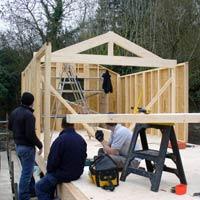
  1. Timber frame garden officeThe timber frame forms the “skeleton” of your eco-friendly garden room. The timber frame wall panels support all of the weight/load of the building, down to the foundations.
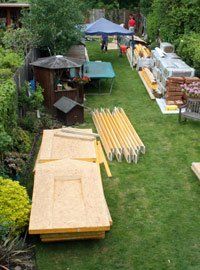
  2. The frames are accurately manufactured in our suppliers workshop, in a controlled environment away from the weather. The panels are then rapidly erected on site and with rafters to form the roof, and joists to form the floor.
  3. A weather-tight garden office or garden room is completed in days. Granny annexes take longer.
  4. The timber frame wall panels are made of softwood vertical studs and horizontal rails, filled with wood-based panel sheathing. The sheathing provides wind resistance. Once the frame is constructed in your garden our team fill it with layers of insulation and finish it internally with plasterboard and skim.
  5. A breather membrane on the external face of the timber frame panels protects them during construction and provides additional insulation and secondary protection behind the larch cladding.
  6. The timber frame building method gives us flexibility in the layout and appearance of your garden office or annexe.
  7. The panels can be made small enough to fit through narrow gates and passages.
  8. High levels of thermal insulation are incorporated within all our buildings, reducing heating costs and conserving energy.
  9. Timber is the only renewable construction material and the softwood used in timber framing is sourced from sustainable British and European forests.
  10. Timber frame contruction is used extensively for houses, schools, hotels, offices and sports facilities. Buildings up to eight storeys high can be constructed using timber frame.

Back


High performance, wooden doors and windows

  1. high performance windows and doorsDesign: Our craftsman-made windows and doors can be varied in size. Alternative door and window designs for your garden room or garden office are available. We can advise on appropriate styles
  2. Flexibility: The number of windows/doors and their layout are flexible and are arranged specifically for your garden and the building orientation.
  3. Security: Windows have lockable stays. French doors and single doors have multiple point espagnolette locking system, as required by house insurers.
  4. Natural Woods: Doors and windows are made from engineered softwood, which is guaranteed for ten years. Hardwood and oak are also available.
  5. Wood colours: A low maintenance, weatherproof, low-Toxicity wood stain is applied in the workshop, in a colour of your choice.

Double glazing helps retain heat in winter and reflect it away from the building in summer.

  • All double glazing has a 24mm argon filled gap between the panes.
  • Panes are made with soft coat Low Emissivity glass.
  • Double glazed units have a “warm edge” which reduces heat loss of the panes by 85%.
  • The units are toughened for safety in doors and large windows.

Well engineered wooden doors and windows last longer than uPVC and are less affected by direct sunlight. A wooden window can be repaired in the future if necessary. a uPVC widow or door has to be replaced. The appropriate choice for eco-friendly garden rooms and offices.

Back


Velux roof windows.

  • Garden office roof with VeluxesRoof windows provide all-year-round natural light over your desk or drawing board.
  • They provide instant fresh air in summer. Hot air rises, straight out of the roof window.
  • Available in a range of shapes and sizes. The most popular size that we install is 98cm x 78cm.

Back


Heartwood larch cladding

Exterior walls are clad with heartwood larch grown in managed forests in Scotland and Northumbria. It is a beautiful, honey coloured wood with a 25 to 50 year life span, depending upon local conditions. Larch cladding provides subtle, natural decoration and serious weather protection.

  1. Vertical larch claddingNo Maintenance: Traditionally larch is used for boat building because it is naturally water resistant. The larch we use to protect our garden offices and granny flats come from the centre of the tree, where the fibres are densely packed. This density combined with larch’s natural resins means that no chemicals or wood preservatives are needed. Thus reducing the environmental impact of the building.
  2. Weather protection: The density mentioned above means that larch acts as a rain sceen and sun screen.
  3. Direction: The exterior larch cladding can be either vertical or horizontal, depending upon your taste and the requirements of your local planning department.
  4. Colour: Coloured wood stains can be used on heartwood larch to great effect, but most clients choose to leave the larch in its natural state.
  5. Silvering: If you don’t paint the exterior of your building it will weather to a silvery grey colour.

Back


Cedar Shingle Roof tiles.

Neighbours love cedar shingles. A downside of most garden buildings is that both you and the neighbours end up looking at an unsightly flat, black membrane roof when you look out of an upstairs window. Cedar tiles create a mellow and attractive roof that blends into your garden environment.

  1. Eco-friendly cedar shingle roofTop grade Blue Label cedar shingles do not require chemical maintenance and are guaranteed for 35 years.
  2. Each tile is individually nailed to your building.
  3. They are highly resilient to all aspects of UK weather, including high winds and storms.
  4. Cedar shingles are 100% heartwood and sourced from well-managed forests. They are cut from small logs that would otherwise be left as forest waste.
  5. Cedar shingles have higher natural insulation properties than tile, plastic or rubber roofing.

Ceiling – Internal

All InsideOut ceilings are vaulted. At their lowest point internally they are 2.07m rising up to 2.7m at the highest point; or taller if your building is wider.

We can easily make your ceiling higher if you would like more room for storage or creating large artworks.

Back


Traditional plastered walls

plastered wallsPlastered walls provide a substantial, smooth base for decoration. The plasterboard provides 30 minutes internal fire protection.

Because of the timber frame construction, you can attach shelves to the walls and hang things from the ceiling.


The floor

The structural floor is made of ply on substantial floor joists. The floor of your building is the same strength as the first floor in a house. We can make an even stronger floor for you if you want to put heavy, specialist equipment in your building.

The floor is suitable for carpeting or adding a wooden of laminate floor on top. Our building team can fit a wood or laminate floor of your choice, if you wish them to.


Plumbing and electrical

Fitting a loo, shower room or kitchen area

Garden office plumbingEach plumbing project is costed on its own merits, depending on the size of room and level of specification you want. There are guide prices in our price list to help you get a feel for plumbing.

Options:

  1. Sinks and drainage for painting and crafts, or for people who want to make a cup of tea
  2. Loo and wash basin for people who want to separate work from home
  3. Shower rooms for guest rooms, therapy rooms and home gymnasiums
  4. Outside tap or gardening sink

If your building is lower than your drains, don’t worry, we have the solution.


Electrical specification

lighting for garden officeOur quoted prices include internal wiring, low energy light fittings and a consumer unit. If you have requested a sink or wash basin your quote will also include a water heater.

Sockets and lights

The number of sockets and lights is your choice but even our smallest garden offices and garden rooms have eight or ten double sockets, three low energy wall lights and an external security light.

Larger offices have twelve to sixteen double sockets, four or five low energy wall lights and external security lighting.

We use local electricians for wiring. If you have a favourite electrician, he or she is welcome to work with us.

  1. We include light fittings for people who are too busy to select their own. But, you are welcome to supply your own fittings.
  2. Data cabling can be installed when the electrical connection is extended from the house.
  3. External electrical socket or additional outside lighting can easily be arranged for you.
  4. There is an additional charge for bringing electricity from the house to your garden building.

Heating

You are unlikely to need more than a 2.5kw convector heater, even in a large office. This is because of the high levels of insulation in each building.

photo voltaic panels Adding photo voltaic panels

You can generate a percentage of your own electricity with photovoltaic panels. This is not a cheap option, but it is viable if the roof of your eco-friendly garden room is large enough, faces the right way and you intend to live in your current house for a long time. Please phone us for more information.


Foundations

Real buildings need real foundations

Garden office foundationsA permanent garden office or garden room needs solidly constructed foundations to protect it from variable ground conditions and to stop it blowing away in storms. Unpredictable weather in the UK means that ground conditions can go from drought to flood is a short space of time.

Problems are avoided because we make sure your building has appropriately designed foundations.

Our system employs individual concrete cube foundations of approx 90 x 90 x 90cm, set at intervals around the perimeter. A metal foot is placed on each foundation and the building is supported on larch beams that span from foot to foot.

This type of foundation has minimal impact on your garden and allows air to circulate under the floor.

If you have sheds, greenhouses or other items that you want removing as part of your project, this is not a problem.

If you have an existing garage base or other substantial support we can design your building to fit.


The foundation process

  1. When we first visit you, we discuss the best position in your garden for your office or garden room.
  2. We survey your garden to assess any changes in levels, hidden drains, tree roots etc.
  3. Our architect draws the survey and designs the foundation plan.
  4. We find suitable ground workers in your area to tender for installing your foundations and drainage. If you have a favourite builder we will work directly with him to create your foundations.


Now you have an idea of how and what we build, would you like to see one?

If yes, please phone or email and we will find the nearest eco-friendly garden room for you to visit. We have many kind clients who are happy to show their offices and garden rooms to people like you. This gives you the chance to find out how a building would work for you.